
Drone & RC components
Choosing a drone or RC servo: torque, voltage, size and control interface
Compare servos for civilian drones, RC models and robotics using the actual voltage, load, travel, spline and controller requirements. Prepare a clearer parts enquiry.
Ask about this requirementThe quick answer
Choose a servo against the complete application: required movement and load, available regulated supply, mechanical space, output spline and controller interface. Torque figures are meaningful only with their stated voltage and test conditions, and stall torque is not a continuous working-load rating. A matching three-wire plug does not prove electrical or protocol compatibility. Keep the exact model and variant distinct, and confirm the manufacturer's current data before supply.
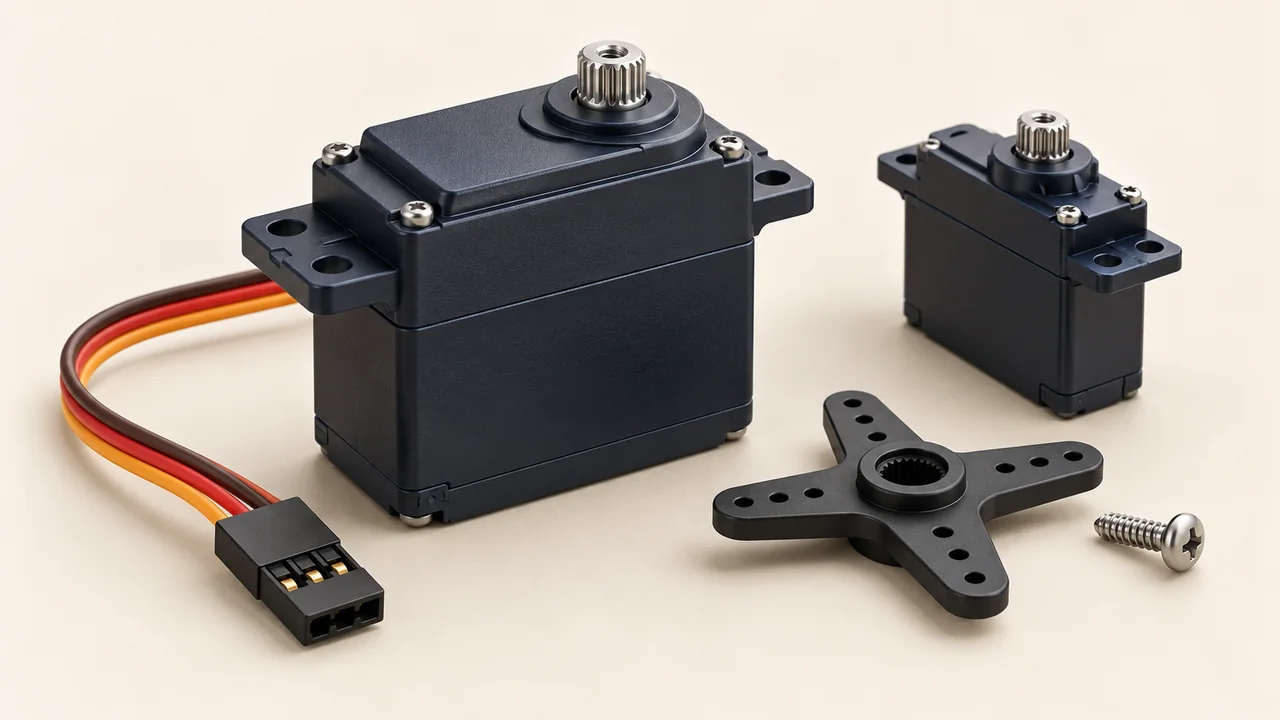
Illustrative example — not a real customer case
A worked purchasing example: A replacement servo needs more than a torque match
An illustrative RC customer finds a servo with a higher advertised torque than the installed one. Its supply requirement, spline and control compatibility have not been compared.
What to include
- Record the installed model, actual regulated supply and controller output.
- Compare torque and speed under the same stated conditions, then check case, mounting, spline and travel.
- List the exact proposed servo and any compatible horn/programmer as separate items for confirmation.
What this resolves
The customer receives a configuration-aware offer instead of assuming a bigger torque number makes the candidate interchangeable.
Define movement and the real power arrangement
State whether you need a positional, continuous-rotation, linear or other specifically identified servo. Describe the intended travel, linkage and application rather than asking for the strongest unit that fits. Record the regulator or receiver-bus voltage and available current, including how the system is actually powered; a battery's name alone does not define the voltage at the servo. Compare published speed and torque at the same stated operating condition. Consider the manufacturer's current information when planning the supply, and do not treat a stall figure as a normal continuous operating point.
Check the case, mounting and output connection
Use the exact mechanical drawing to compare case dimensions, mounting ears, available clearance and output location. Confirm spline type and the appropriate horn or arm; similar-looking output shafts need not share the same fit. Identify the required travel and any programming or setup accessory before quoting. A digital or metal-geared description does not specify every mechanical feature or environmental limitation. For a replacement, send the current model, accessible photographs and the space constraints. Keep any proposed horn, programmer or lead as a separate clearly identified package item.
Match the control signal to the particular variant
Ask what signal or bus the receiver/controller outputs and what the exact servo variant accepts. Do not infer pulse settings, refresh rate, connector pinout or a named bus protocol solely from 'digital servo' or plug shape. Programming capability also varies by model and compatible accessory. For civilian drones, RC models and robotics in Israel, include the intended use and required quantity so the supply enquiry reaches the right equipment family. Follow manufacturer setup instructions in a secured, unpowered-propulsion test arrangement where relevant; this guide is for selection and does not define a flight-control installation or certify an application.
What to compare
| Compare | Specify | Avoid this shortcut |
|---|---|---|
| Load and motion | Application, travel and linkage requirement | Largest stall-torque number always wins |
| Supply | Actual servo-bus voltage and current capability | Battery label proves compatibility |
| Mechanical fit | Case, mounting, spline and horn | Similar shaft or case means a direct fit |
| Control interface | Exact controller signal and accepted variant | Digital or three-wire means one universal protocol |
Your enquiry checklist
0 / 6 checked
Common mistakes to avoid
- Comparing torque values quoted at different voltages
- Treating stall torque as a continuous load rating
- Assuming digital, bus-compatible and programmable mean the same thing
Related products and services
Common questions
Does a higher-torque servo always make a better replacement?
No. It also has to meet the movement, power, mechanical and control requirements. Compare the complete application and the exact manufacturer's data.
Will any horn fit a similar-looking servo spline?
Do not assume that. Confirm the specified output spline and the compatible horn/arm reference for the particular model.
Is every digital servo compatible with a serial bus?
No universal compatibility follows from the word digital. Check the exact variant's accepted signal/protocol, controller requirements and any needed programming accessory.
Sources and further reading
Ask about this requirement
Your topic is carried into the enquiry. No account or payment details are needed.
Ask about this requirementService & AOG in Israel